
Fluorescence quantitative PCR (qPCR) in food safety
In today's society, people's demand for safe and high-quality food is growing, and the application of advanced technologies such as fluorescence quantitative PCR (qPCR) in the field of food safety has become increasingly important. In the field of food safety, qPCR offers many advantages in terms of efficiency and cost-effectiveness.
qPCR in food safety:
qPCR has high sensitivity and specificity, which can be used to detect target pathogens and contaminants in food samples. By amplifying and detecting specific DNA or RNA sequences, tiny amounts of target substances can be detected using fluorescent probes, thereby reducing the risk of false negatives and false positives, which can reduce costs in terms of time, resources, and potential health risks.
qPCR is its rapidity and accuracy. Compared with traditional culture-based methods, qPCR can detect and quantify pathogens or contaminants in a matter of hours, while traditional methods require days or even weeks. This faster detection and quantification process could lead to a faster response to a potential outbreak, improving overall food safety.
qPCR is also very flexible in detecting target substances. This includes various foodborne pathogens such as Salmonella, Listeria, and E. coli, as well as allergens and other contaminants. This flexibility makes qPCR an important tool for ensuring the safety and accurate identification of food products.
qPCR in food safety:
In addition to its high efficiency, qPCR is also cost-effective compared to traditional pathogen detection methods. While the initial cost of a qPCR device may be higher, the cost of consumables, labor, and time required to perform the test is typically lower. For example, qPCR can use smaller sample volumes and require less time and labor than traditional culture-based methods. This can result in significant cost savings for food producers and regulators, while increasing efficiency and productivity.
In addition, the use of qPCR can reduce the costly recall efforts and potential legal action required by foodborne disease outbreaks. qPCR provides faster and more accurate detection, which can shorten response time and reduce the likelihood of large-scale outbreaks and associated costs.
qPCR in food safety:
Based on the above advantages, qPCR is widely used in the field of food safety. Through qPCR technology, it can quickly and accurately detect microorganisms, viruses, bacteria, and other harmful substances in food, such as Salmonella, Escherichia coli, Staphylococcus aureus, etc., so as to ensure the health of consumers and the quality and safety of food. Here are some specific application cases:
-
Detection of pathogenic microorganisms in aquatic products. Using qPCR technology can quickly and accurately detect pathogenic microorganisms in aquatic products, such as Vibrio parahaemolyticus and Aeromonas halophilus. These pathogenic microorganisms are easy to cause food poisoning and infectious diseases, so the detection of pathogenic microorganisms in aquatic products is very important to protect the health of consumers.
-
Detection of bacteria in fresh meat: qPCR technology can quickly and accurately detect bacteria in fresh meat, such as Salmonella, Escherichia coli, and so on. These bacteria can easily cause food poisoning and infectious diseases, so the detection of bacteria in fresh meat is very important to protect the health of consumers.
-
3. Detection of allergens in plant foods: Using qPCR technology, we can quickly and accurately detect allergens in plant foods, such as peanuts, soybeans, and wheat bran. These allergens are easy to cause food allergic reactions, so the detection of allergens in plant foods is very important to protect the health of consumers.
In general, qPCR has become an important tool for ensuring the safety and quality of our food supply. Its high sensitivity and specificity, speed and accuracy, and versatility in detecting a range of target substances make it an efficient and cost-effective choice for food safety testing. By using qPCR in food safety testing, food manufacturers and regulatory agencies can improve efficiency, reduce costs, and ultimately ensure that the food we consume is safe and of the highest quality.
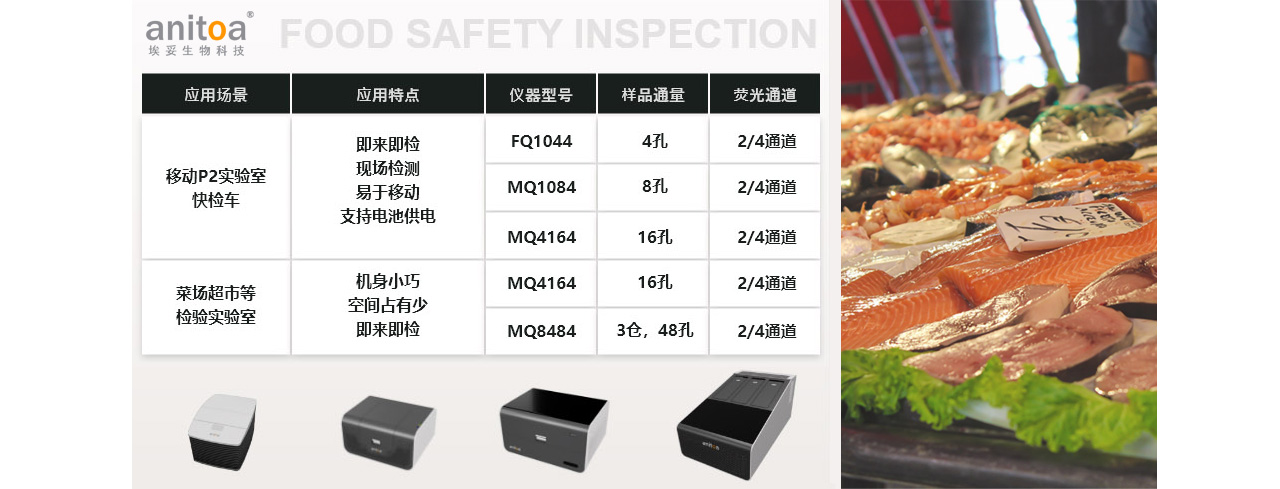
Anitoa-an innovative company for deep-farming fast, small-scale qPCR technology
Anitoa is a professional R & D and production enterprise of molecular diagnostic qPCR instruments. It has core chip technology, optical technology, and patented technologies such as rapid heating, microfluidic control, and supporting reagents with independent intellectual property rights. The instruments developed by Anitoa are characterized by fast and simple small instruments, and the expensive and complex large PCR instruments are developed into truly portable products.
We offer affordable, easy-to-use solutions that empower researchers and professionals to advance their work in a variety of fields, including food safety. Our cutting-edge qPCR instruments are designed to meet the needs of users with different applications, from laboratory research to field testing.
With our focus on quality, reliability, and affordability, Anitoa is committed to helping our customers achieve their goals in food safety and beyond. Contact us to learn more about our qPCR instrumentation solutions for food safety and other molecular diagnostics.