
Why PCR Assay Companies Do Not Always Need to Develop Their Own qPCR Instrument
For a PCR assay company, offering a dedicated qPCR instrument together with its reagents can be highly attractive.
An integrated assay-and-instrument solution can simplify workflows, provide a more consistent user experience, and help establish a complete product offering.
This often raises an important question: Should we develop our own qPCR instrument?
Building an instrument in-house may be the right decision for some companies. For others, working with an established, open qPCR platform can offer a more practical path to market.
Developing a qPCR Instrument Takes More Than a Working Prototype
A qPCR instrument combines several engineering systems. Beyond running thermal cycles and detecting fluorescence, a commercial product requires reliable operation, consistent manufacturing, and ongoing technical support.
Key development areas include:
Optical Detection
Fluorescence sensitivity, background noise, channel separation, signal consistency, and dye compatibility all affect assay performance, particularly in multiplex PCR.
Thermal Control
Heating and cooling rates are only part of the picture. Temperature accuracy, well-to-well uniformity, thermal stability, and assay performance under different cycling protocols also matter.
Electronics and Embedded Software
Instrument control requires coordination between thermal regulation, fluorescence acquisition, power management, sensors, and communication interfaces.
Operating Software and Data Analysis
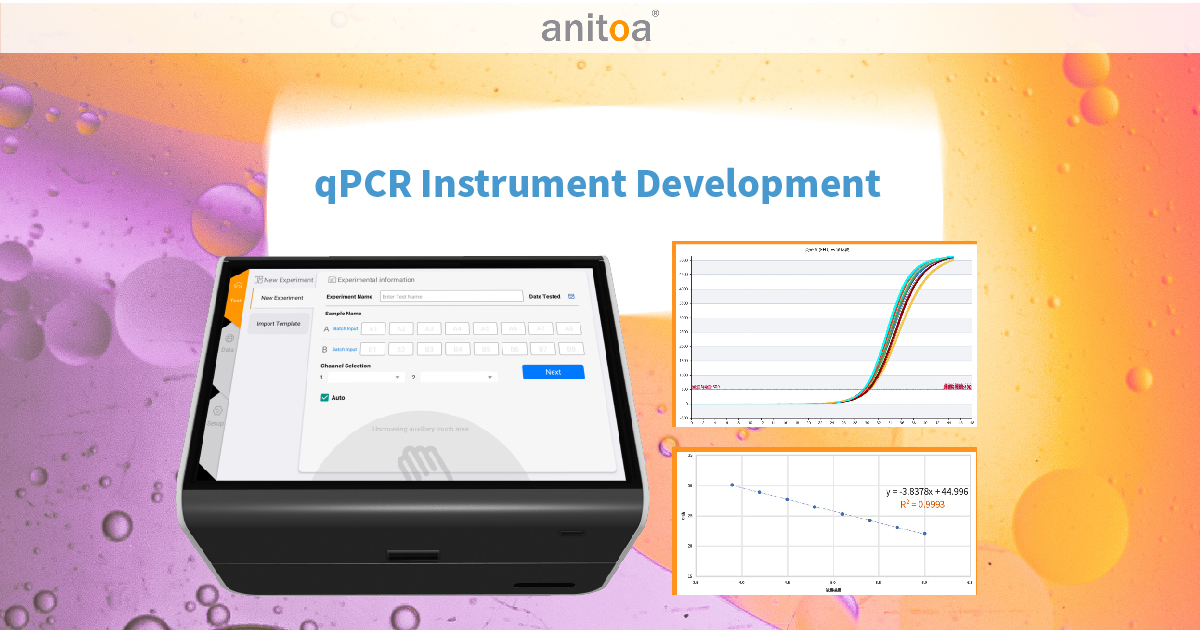
A complete workflow may involve experiment setup, amplification monitoring, Ct/Cq calculation, standard curves, melting curves, result interpretation, and data export.
Mechanical Design and Consumables
Instrument dimensions, heat dissipation, tube compatibility, lid design, and ease of operation become particularly important for compact or portable systems.
Manufacturing, Quality Control, and Support
Production testing, component consistency, software maintenance, troubleshooting, and after-sales service are essential for reliable commercial delivery.
These requirements explain why moving from a laboratory prototype to a stable, commercially supported instrument can involve substantial time and engineering resources.
When Does In-House Instrument Development Make Sense?
Developing a proprietary qPCR instrument can be worthwhile when the instrument itself is central to a company's long-term product strategy.
It may be appropriate when a company has sufficient projected sales volume, an established multidisciplinary engineering team, and specific technical requirements that existing platforms cannot meet.
In-house development also offers greater control over instrument architecture and future product development.
However, for companies whose main expertise lies in reagent chemistry, assay development, or diagnostic applications, building a complete instrument development and manufacturing operation may divert significant resources from their core business.
What Can an Established qPCR Platform Offer?
Working with an experienced instrument manufacturer does not necessarily mean accepting a fixed, off-the-shelf product.
An open qPCR platform can provide the core instrument architecture while allowing partners to develop their own assay workflows and product configurations.
Depending on the platform and project requirements, cooperation may include:
-
Assay compatibility evaluation and protocol optimization
-
Fluorescence channel and throughput configuration
-
Software, data processing, and report adaptation
-
Branding, labeling, packaging, and OEM/ODM support
-
Prototype validation and production planning
An established platform can shorten the initial development process because its core optical, thermal, electronic, and software systems have already undergone engineering development and production testing.
It also allows assay companies to focus more resources on reagent performance, application validation, market requirements, and customer support.
What Should Assay Companies Evaluate Before Choosing a Platform?
Choosing a qPCR platform should involve more than comparing instrument prices or headline specifications.
Several questions deserve attention.
Does the instrument support the existing assay?
Check fluorescence dyes, detection channels, reaction volume, consumables, and thermal protocols. Actual compatibility should be verified experimentally.
Can the platform deliver the required assay performance?
Evaluation may include amplification consistency, repeatability, low-concentration detection, linearity, or multiplex performance, depending on the assay.
Does the software support the intended workflow?
Experiment setup, result interpretation, data management, and reporting may be just as important as hardware specifications.
What is available today, and what requires development?
Standard features, optional configurations, customization work, and planned capabilities should be clearly distinguished.
Can the manufacturer support continued production and service?
Manufacturing experience, quality control, documentation, software maintenance, and technical support matter beyond the initial prototype stage.
From Instrument Development to Product Collaboration
For many PCR assay companies, a more useful question may be: How can we build a complete testing product around an established instrument platform?
In this approach, the assay company contributes its reagent technology, application knowledge, and market requirements. The instrument partner provides the hardware platform, system engineering, software, manufacturing, and technical support.
Both parties work together to verify assay compatibility, define the workflow, and prepare the final product for its intended market.
This approach can provide more flexibility than purchasing a standard instrument, without requiring the assay company to develop every part of the system from scratch.
How Anitoa Supports PCR Assay and Instrument Projects
Anitoa develops and manufactures compact, portable real-time qPCR instruments based on proprietary ultra-low-light CMOS image sensing technology and a fixed optical architecture.
Our Maverick MQ4 platform provides an open instrument foundation for assay partners, with configurations suited to focused low-volume testing, routine small-batch workflows, and multiplex applications.
For PCR reagent manufacturers, assay developers, and diagnostic brands, Anitoa supports evaluation of assay compatibility, fluorescence channels, PCR protocols, software requirements, and data workflows.
OEM/ODM options include branding, packaging, selected instrument configurations, and software adaptation. More extensive engineering or integration work can be evaluated separately according to project scope and expected production volume.
By building on a mature qPCR platform, partners can concentrate on what differentiates their products while working toward a complete molecular testing solution.
Frequently Asked Questions
Do PCR reagent companies need to develop their own qPCR instruments?
Not necessarily. The decision depends on product strategy, technical requirements, engineering resources, and expected commercial volume.
Can an existing PCR assay be used on a different qPCR platform?
Potentially, but compatibility must be evaluated. Fluorescence channels, consumables, thermal protocols, and result interpretation may require verification or adjustment.
Is qPCR OEM/ODM limited to adding a company logo?
No. Depending on the project, it may include configuration, branding, software adaptation, assay integration, and product documentation.
What information is needed for an initial platform evaluation?
The assay type, fluorescence dyes, reaction conditions, consumable format, intended application, target market, and estimated order volume are useful starting points.
Discuss Your qPCR Instrument Project
If you are looking for an instrument platform to complement an existing PCR assay or planning a branded portable qPCR product, Anitoa can help evaluate the available options.
Share your assay requirements, fluorescence channels, intended application, and target market to begin a preliminary technical discussion.
by Anitoa Product and Engineering Team
July 29, 2026